Bar, Montenegro – Comprehensive City Guide
Overview
Bar is a major port city on Montenegro’s southern Adriatic coast, home to approximately 40,000 residents in the municipality. It is one of the oldest continuously inhabited settlements on the Montenegrin littoral, with archaeological evidence dating back to the Bronze Age. Known in antiquity as Antibarium (or Antivari in Italian), the city sits at the foot of Mount Rumija (1,594 m) and uniquely straddles two shores – the Adriatic Sea and Lake Skadar, the largest lake in the Balkans. Bar is Montenegro’s principal seaport, the terminus of the Belgrade-Bar railway, and the departure point for ferry services to Italy, making it an indispensable transportation hub and gateway to the country’s southern coast.
Despite being less touristically developed than Kotor or Budva, Bar rewards visitors with a wealth of history spanning Roman, Byzantine, medieval Serbian, Venetian, and Ottoman periods; one of Europe’s largest open-air archaeological sites at Stari Bar; the oldest olive tree on the continent; and authentic Mediterranean culture largely untouched by mass tourism.
1. History
Ancient and Roman Origins
The area around Bar has been inhabited since the Neolithic era. The first settlement on the territory of what is now Stari Bar (Old Bar) was established at the beginning of the Bronze Age. The indigenous Illyrian tribes were the earliest known inhabitants, and their presence shaped the region’s early cultural identity. Following Rome’s expansion into the eastern Adriatic, the Romans established a settlement they called Antibarium – literally “opposite Bari,” reflecting its geographic position across the Adriatic from the Italian city of Bari [1][2].
Recent archaeological excavations at the Stari Bar site have revealed occupation layers dating as far back as 800 BC, significantly pushing back the timeline of known settlement in the area [3].
Byzantine and Early Medieval Period
After the fall of the Western Roman Empire, Antibarium came under Byzantine control as part of the Theme of Dyrrhacium. The city was mentioned as the reconstructed Roman castle “Antipargal” in the 6th century, and the name “Antibarium” was formally recorded for the first time in the 10th century [1].
The Bar Archbishopric and Medieval Serbian Rule
One of Bar’s most significant historical contributions is its role as an ecclesiastical center. The Archbishopric of Bar was established as a diocese in the 9th century and elevated to a full archdiocese in 1089, when it was confirmed by Pope Clement III. The Archbishops of Bar bore the prestigious title of “Primates of Serbia” (Primas Serbiae), underscoring the city’s religious importance to the entire region [4][5].
Stefan Vojislav incorporated Bar into his state around 1040, and the Vojislavljevic dynasty held it until 1090. The city subsequently became part of the medieval Serbian state under the Nemanjic dynasty. The archbishopric was briefly abolished after 1140 but was restored by the Nemanjic dynasty in 1199, reaffirming Bar’s importance as a spiritual and administrative capital [4][5].
During this period, Bar produced one of the oldest Slavic literary monuments – the “Genealogy of Bar” (Barski Rodoslov / Ljetopis Popa Dukljanina), a medieval chronicle of immense historical value that documents the rulers of the Slavic principalities in the region [6].
Venetian Period
Like much of the Adriatic coast, Bar passed through periods of Venetian control. The Republic of Venice valued the city for its strategic maritime position and fortified its defenses. The Haj-Nehaj Fortress near Sutomore was built by the Venetians in the 15th century specifically to defend their southern border from the advancing Ottomans [7][8].
Ottoman Period (1571-1878)
The Ottomans captured Bar in 1571, beginning over three centuries of Ottoman rule that profoundly shaped the city’s cultural and architectural character. Under Ottoman administration, many churches were converted to mosques, including the Cathedral of St. George, which was repurposed as a gunpowder depot. The Ottoman period brought new architectural elements – hammams, bazaars, and mosques – that blended with the existing Romanesque and Byzantine structures, creating the distinctive multicultural layering visible in Stari Bar’s ruins today [1][9].
The Ottoman conquest had a devastating effect on the Roman Catholic Archdiocese of Bar. Emigration of the indigenous Catholic population and immigration of new ethnic and religious groups led to the gradual collapse of Catholic parish structures; entire parishes were converted to Orthodoxy due to a shortage of Catholic priests [5].
Liberation of 1878
Following the Russo-Turkish War (1877-78), the Treaty of Berlin in 1878 ceded Antivari to the Principality of Montenegro, ending over 300 years of Ottoman rule. This marked a pivotal moment in both Bar’s and Montenegro’s history, as Bar became a key component of the newly recognized independent Montenegrin state. Prince Nikola I of Montenegro began modernizing the city, and construction of the modern port commenced in 1905 [1][10].
The 1979 Earthquake
On April 15, 1979, a devastating earthquake measuring magnitude 6.9 struck with its epicenter in the Adriatic Sea between Bar and Ulcinj. The earthquake registered X (Extreme) on the Mercalli intensity scale and caused catastrophic damage throughout the Montenegrin coast. In Bar, the destruction was so severe that much of the city had to be rebuilt entirely [11][12].
The ancient settlement of Stari Bar, already in decline, was completely abandoned after the earthquake. The aqueduct that had supplied water to the old town was destroyed, and the remaining inhabitants relocated to the new coastal settlement. A total of 101 people died in Montenegro and 35 in Albania, with over 100,000 left homeless. According to a 1984 UNESCO report, 1,487 culturally significant objects were damaged across the affected region [11][12].
Paradoxically, the earthquake’s destruction led to the construction of the modern city of Bar visible today, including the port facilities that have proved vital to Montenegro’s economy.
2. Top Attractions
Stari Bar (Old Bar Ruins)
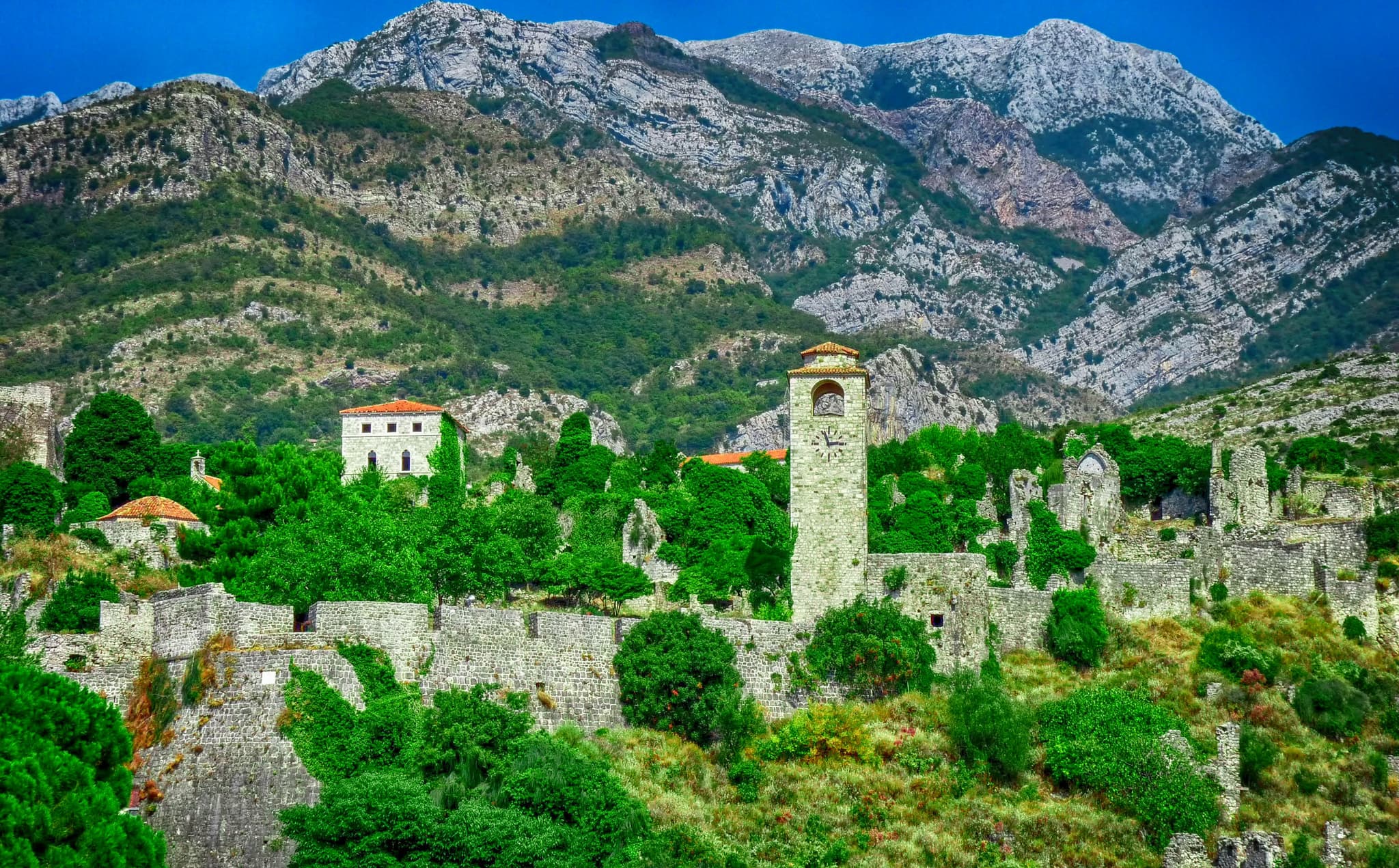
Stari Bar is the crown jewel of Bar’s cultural heritage and one of the largest medieval archaeological sites in the Balkans. This fortified hilltop settlement spans approximately 4 hectares and is situated 4 kilometers from the sea at the foot of Mount Rumija. The ruins contain the remains of approximately 600 public and sacral buildings, bearing witness to every major period of Mediterranean civilization [3][13][14].
The fortress was built and expanded between the 10th and 18th centuries. Key structures include:
- The Main Gate (14th-16th century) – the imposing entrance to the fortified city
- Saint Nicola’s Church (13th century) – one of the best-preserved religious structures
- Tatarovica Citadel (10th-19th century) – the inner fortress with military chapel
- The Clock Tower (1753) – featuring clocks on all four sides, the most iconic landmark
- Saint George’s Cathedral (11th-15th century) – originally Romanesque, converted to a mosque under Ottoman rule, and ultimately destroyed by a gunpowder explosion in 1881 [3][13][14][15]
- The Aqueduct at Tatarovica – destroyed in the 1979 earthquake
- 11th and 12th-century Byzantine city walls – still draped in thick Mediterranean vines
Stari Bar is on the UNESCO World Heritage Site Tentative List, and ongoing restoration work is gradually transforming the site into an open-air museum [16]. The entrance fee is modest (typically 2-3 EUR), and visitors can spend several hours exploring the atmospheric ruins.
Practical tip: The walk from the parking area to the fortress entrance passes through a charming lane of restaurants and shops selling local olive oil, honey, and handcrafts.
King Nikola’s Palace (Villa Topolica)
The elegant King Nikola’s Palace was constructed in 1885 on Bar’s waterfront, built on the ruins of the villa of the last Turkish lord of Bar, Selim-bey Mustafagic. King Nikola I Petrovic-Njegos – the first and last King of Montenegro – gifted the palace to his daughter Princess Zorka and his son-in-law Prince Petar Karadjordjevic (who later became King Peter I of Serbia). Petar named the estate “Villa Topolica” after the town of Topola in Serbia [17][18].
The complex includes the large and small palace buildings, a chapel, guard houses, and a winter garden. A spacious ballroom was added in 1910. Since 1959, the complex has served as the municipal museum of Bar, housing permanent exhibits of archaeological, historical, ethnological, and art collections, along with royal furniture and folk costumes [17][18].
The palace is surrounded by attractive Mediterranean gardens with lush palm trees and faces directly onto Topolica Beach, making it a natural starting point for waterfront exploration.
The Old Olive Tree of Mirovica (Stara Maslina)
One of Bar’s most remarkable attractions is the Old Olive Tree, located in the village of Mirovica near Stari Bar. Experts from the Istanbul Forestry Faculty have estimated the tree’s age at approximately 2,247 years, making it the oldest olive tree in Europe and one of the oldest in the world [19][20][21].
The tree has a circumference of 10 meters and still bears fruit. Despite having survived fires twice during its long lifespan, it continues to produce olives that are harvested and used to make healing olive oil. The tree has been a protected natural monument by law since 1963 and is a candidate for UNESCO World Heritage status [19][20].
According to local legend, feuding families would come to the tree to make peace with each other, which is how the village of Mirovica earned its name – the root of the word “mir” meaning “peace” in South Slavic languages [20].
The site is fenced and maintained, with a modest entrance fee (approximately 1 EUR). A small souvenir shop offers olive oil products and mementos.
Haj-Nehaj Fortress
Perched at an altitude of 231 meters above the town of Sutomore (in Bar municipality), Haj-Nehaj is a 15th-century Venetian fortification built to defend against Ottoman expansion. The fortress’s name comes from the Arabic phrase meaning “fear not” [7][8].
Within the walls stands the Church of Saint Demetrius, dating from the 8th century, which uniquely features two altars – one Orthodox and one Catholic – a powerful symbol of the religious coexistence that characterized the region [7].
The fortress suffered significant damage in the 1979 earthquake, but the climb (approximately 30 minutes through pine forest on a steep stony path) is rewarded with breathtaking panoramic views spanning the Sutomore Bay and Bar Bay [7][8].
Marina Bar
Marina Bar is one of Montenegro’s largest and best-equipped marinas, located at the Adriatic Sea’s entrance, 104 nautical miles from the Strait of Otranto. The marina offers approximately 700 serviced berths with full shipyard facilities including a 75-tonne travel lift, electrical and mechanical workshops, and a fuel station [22].
With approximately 270 sunny days per year, Marina Bar is one of the sunniest nautical ports in the Mediterranean. The marina serves as a popular base for yachting, sailing, and coastal exploration of Montenegro’s southern Adriatic coast [22].
Topolica Beach
Topolica City Beach is Bar’s central beach, stretching approximately 500 meters from the Bar Marina to the Zeljeznica river. Located directly in front of King Nikola’s Palace, this wide pebble beach (with some sand and larger stones) is one of the most accessible and well-serviced beaches in Bar [23].
The palm-lined promenade behind the beach is lined with bars, restaurants, and cafes, and the beach itself offers full services including lounger and umbrella rental, children’s playgrounds, and beach clubs. It is considered an ideal family beach [23].
Other notable beaches in the Bar municipality include Susanj Beach, Canj, and the small coves toward Sutomore.
3. Culture and Events
The Olive Tradition
Olive cultivation is fundamental to Bar’s identity and economy. The Romans planted the first olive groves on the Montenegrin coastal slopes over 2,000 years ago, and by the 6th century, olive oil production was an established part of local culture. Today, more than 1,700 growers continue this tradition, tending approximately 10,000 ancient zutica olive trees – an indigenous species that produces oil renowned for its golden color and exceptional balance of fruitiness and piquancy [24][25].
The UN Industrial Development Organization (UNIDO) has recognized the significance of Montenegro’s ancient olive groves, and local producers from Bar and Ulcinj have jointly developed the 42N 19E olive oil brand, highlighting the unique terroir of the region [24].
Maslinijada (Olive Festival)
Maslinijada (translating roughly to “Olive Day”) is Bar’s signature cultural event, held annually in November in the atmospheric setting of Stari Bar. Inaugurated in 2002, the festival celebrates the olive harvest with:
- Tastings and sales of olives, olive oil, and specialty products
- Exhibitions by beekeepers, winemakers, and growers of medicinal plants
- Music, folk dancing, and traditional Montenegrin cuisine
- Fireworks illuminating the bay
- Exhibitions of traditional folk costumes historically worn in the Bar area [26][27]
Maslinijada plays an important role in preserving and promoting Montenegrin olive-growing traditions, supporting the local economy, and contributing to agritourism development.
Bar Chronicle (Barski Ljetopis)
The Bar Chronicle is a distinguished multimedia cultural festival held annually in July and August since 1988. Organized by the Bar Cultural Center, it is a comprehensive program that includes:
- Theatre performances by domestic and international troupes
- Art exhibitions and installations
- Literary evenings and poetry readings
- Concerts of traditional and classical music
- The Mediterranean Book Fair (added in 2003), which is the festival’s literary centerpiece [6][28]
The Mediterranean Book Fair is particularly fitting, as Bar is the birthplace of the medieval “Genealogy of Bar,” one of the oldest Slavic literary monuments.
Multicultural Heritage
Bar’s cultural fabric reflects its extraordinary history under Byzantine, Serbian, Venetian, and Ottoman rule. This layering is most visible in the architecture of Stari Bar, where Romanesque churches stand beside Ottoman mosques, Byzantine walls adjoin Venetian fortifications, and the Church of Saint Demetrius within Haj-Nehaj fortress contains both Orthodox and Catholic altars. This multicultural heritage gives Bar a distinct character among Montenegrin coastal cities [7][9].
4. Nature and Activities
Mount Rumija
Rumija (1,594 m) is the imposing mountain that rises directly behind Bar, forming a dramatic natural backdrop between the Adriatic coast and Skadar Lake. The elevation difference from sea level exceeds 1,500 meters – one of the most dramatic vertical drops in Montenegro [29].
The standard hiking route begins from Bar, traversing the rustic villages of Velembusi and Baltina along a 9.4 km route. The hike is rated moderate with approximately 1,200 meters of elevation gain over 15 kilometers. Beyond the treeline, hikers are rewarded with a spectacular 360-degree panorama encompassing the Adriatic Sea, the city of Bar, Skadar Lake, and mountain peaks stretching into Albania [29].
Rumija holds deep religious significance: every year on Trinity Day (fifty days after Easter), a traditional procession carries Vladimir’s Cross to the summit, uniting participants of all three faiths (Orthodox, Catholic, and Muslim) in a remarkable expression of interfaith harmony [29].
Skadar Lake – Southern Access
Bar is the only town on the Montenegrin Adriatic that provides access to both the sea and Skadar Lake National Park. The main lake gateway, Virpazar, is approximately 25 km from Bar (about 30 minutes by car). Alternatively, the train from Bar to Virpazar takes just 30 minutes and costs approximately 2 EUR [30].
Skadar Lake is the largest lake in the Balkans and one of Europe’s most important wetland habitats, home to approximately 270 bird species including Dalmatian pelicans, pygmy cormorants, and various herons. Boat tours from Virpazar explore the lake’s monasteries, fishing villages, and water lily fields [30].
Beaches
Bar municipality offers a variety of beaches along its stretch of Adriatic coastline:
- Topolica Beach – central city beach, pebble, full services
- Susanj Beach – popular with locals, bars and restaurants
- Canj Beach – a scenic cove beach to the north
- Small coves toward Sutomore – for more secluded swimming
Water is warm enough for swimming from June through September [23][31].
Belgrade-Bar Railway
The Belgrade-Bar railway is one of Europe’s most spectacular and affordable train journeys, connecting the Serbian capital to the Montenegrin coast over 476 kilometers of track. Completed in 1976 after two decades of construction, the line is a marvel of engineering featuring 254 tunnels and 435 bridges [32][33][34].
The most celebrated structure is the Mala Rijeka Viaduct, which at 198 meters above the riverbed was, at the time of its construction, the highest railway bridge in the world. The bridge spans 498 meters in length [32][33].
The journey takes approximately 11 hours and costs around 25 EUR. The most scenic sections are in Montenegro: the crossing over Skadar Lake between Virpazar and Podgorica, and the dramatic mountain ascent between Podgorica and Kolasin through deep gorges and alpine meadows [32][33][34].
Tip: For the best scenery, sit on the right-hand side of the train when traveling southbound (left-hand side going north) [33].
Ferry to Bari, Italy
Bar is connected to the Italian port of Bari by a regular ferry service operated by Montenegro Lines. The crossing takes approximately 8 hours (typically departing late evening, arriving early morning) and operates year-round, with increased frequency in summer (twice weekly from May-November, once weekly in winter) [35][36].
The ferry terminal is located approximately 2 km southeast of Bar’s city center (about 30 minutes on foot), and the service carries both passengers and vehicles. This connection makes Bar a practical gateway between the Balkans and southern Italy [35][36].
Hiking Around Stari Bar
The area around Stari Bar and the foothills of Rumija offers excellent hiking opportunities through Mediterranean scrubland, olive groves, and pine forests. Trails connect Stari Bar to the Old Olive Tree, nearby villages, and up into the Rumija foothills, providing a range of options from easy walks to challenging mountain routes [29][31].
5. Practical Information
Getting There
- By ferry: Regular service from Bari, Italy (approximately 8 hours) [35][36]
- By train: Belgrade-Bar railway terminus; also local trains to Podgorica, Virpazar, and other Montenegrin cities [32][33]
- By bus: Regular connections to Podgorica (1.5 hours), Budva (1 hour), Ulcinj (30 minutes), and other coastal and inland destinations
- By car: Coastal road (E65/Adriatic Highway) connects Bar to Budva (55 km north) and Ulcinj (25 km south); Podgorica is approximately 55 km inland
- Nearest airports: Podgorica Airport (TGD, 60 km) and Tivat Airport (TIV, 80 km)
Port and Transportation Hub
Bar is Montenegro’s largest and principal seaport, handling nearly all of the country’s overseas trade. The modern port, capable of handling approximately 5 million tons of cargo, officially began operations in its current form on July 13, 1983, following post-earthquake reconstruction. The EU has recognized the Port of Bar as an essential element of Montenegro’s transport infrastructure and economy [10].
The city serves as the southern terminus of the Belgrade-Bar railway and has a well-connected bus station with regular domestic and international services.
Climate
Bar enjoys a Mediterranean climate with approximately 270 sunny days per year, making it one of the sunniest locations on the Adriatic. Summers are warm and dry (average July temperatures around 25-27 C), while winters are mild and wet. The swimming season extends from June through September.
Accommodation
Bar offers a range of accommodation from waterfront hotels and modern apartments to family-run guesthouses in the villages around Stari Bar. As a less touristic destination than Kotor or Budva, Bar generally offers better value for money.
Suggested Itinerary (2-3 Days)
- Day 1: Explore Stari Bar ruins and the Old Olive Tree; lunch at the restaurants below the fortress; walk through the olive groves
- Day 2: King Nikola’s Palace museum, Topolica Beach, waterfront promenade; sunset drinks on the seafront
- Day 3: Day trip to Skadar Lake (train to Virpazar, boat tour) or hike to Haj-Nehaj fortress above Sutomore
6. Reviews and Visitor Impressions
An Underrated Gem
Travel writers consistently describe Bar as one of Montenegro’s most underrated destinations. While Kotor and Budva dominate tourist itineraries, Bar offers an equally rich historical experience without the crowds. As one travel blogger wrote: “Bar might not show up in glossy travel brochures, but it’s one of those underrated towns in Montenegro where life moves slower” [31][37].
Stari Bar Impressions
Visitors to Stari Bar frequently describe it as one of their most memorable experiences in Montenegro. The scale of the ruins – 600 buildings spread across a hilltop – combined with the mountain backdrop and relative absence of other tourists creates an almost otherworldly atmosphere. Jules Brown wrote of walking “among the ruins in the lost city of Stari Bar,” capturing the site’s haunting beauty [14][38].
The Old Olive Tree’s Significance
The Old Olive Tree consistently ranks among TripAdvisor’s top-rated attractions in Bar. Visitors are struck not only by the tree’s age (2,247 years by scientific estimate) but by its living presence – the fact that it still bears fruit connects visitors to an unbroken chain of cultivation stretching back to before the Roman Empire. The peace-making legend adds emotional resonance: this was a place where enemies came to reconcile [19][20][21].
The Belgrade-Bar Railway
The train journey is frequently cited as one of Europe’s most scenic and affordable rail experiences. Reviews on TripAdvisor and travel blogs highlight the dramatic mountain scenery, the engineering marvel of the bridges and tunnels, and the sense of adventure in traversing the Balkans by rail for approximately 25 EUR [32][33][34].
Summary
Bar is a city of extraordinary depth. Its history stretches from Bronze Age settlements through Roman, Byzantine, Serbian, Venetian, and Ottoman civilizations. Its archaeological heritage at Stari Bar is among the most important in the Balkans. Its natural setting – between Mount Rumija and the Adriatic, with Skadar Lake just over the mountain – is spectacular. And its living traditions, particularly olive cultivation stretching back over two millennia, connect the present to the ancient past in a tangible, beautiful way.
For travelers willing to look beyond Montenegro’s more famous coastal destinations, Bar offers authenticity, history, natural beauty, and a Mediterranean pace of life that has not yet been transformed by mass tourism.
References
[1] Wikipedia – “Bar, Montenegro” https://en.wikipedia.org/wiki/Bar,_Montenegro
[2] Visit Montenegro – “The History of Bar” https://www.visit-montenegro.com/destinations/bar/info/history/
[3] Montenegro.org – “Ultimate Guide to Stari Bar” https://montenegro.org/stari-bar-montenegro-exploration/
[4] Wikipedia – “Roman Catholic Archdiocese of Bar” https://en.wikipedia.org/wiki/Roman_Catholic_Archdiocese_of_Bar
[5] Wikipedia – “Archdiocese of Bar” https://en.wikipedia.org/wiki/Archdiocese_of_Bar
[6] Bar Chronicle – Olive Queen / Rental Villa in Montenegro https://olivequeen.me/bar-chronicle/
[7] Lonely Planet – “Haj-Nehaj Fortress” https://www.lonelyplanet.com/montenegro/coastal-montenegro/attractions/haj-nehaj-fortress/a/poi-sig/1526208/360152
[8] MonteGuide – “Haj Nehaj Fortress in Sutomore, Montenegro” https://monteguide.com/haj-nehaj-fortress/
[9] MonteGuide – “Old Bar: History and How to Get There” https://monteguide.com/bar-old-town-old-bar/
[10] Wikipedia – “Port of Bar” https://en.wikipedia.org/wiki/Port_of_Bar
[11] Wikipedia – “1979 Montenegro Earthquake” https://en.wikipedia.org/wiki/1979_Montenegro_earthquake
[12] Radio Free Europe – “Montenegro Then And Now: 45 Years After Devastating Earthquake” https://www.rferl.org/a/montenegro-earthquake-1979/32907282.html
[13] Panacomp – “Old Bar – Stari Bar Montenegro” https://www.panacomp.net/old-bar-stari-bar-montenegro/
[14] Jules Told Me – “Among the Ruins in the Lost City of Stari Bar, Montenegro” https://julestoldme.com/2019/10/23/among-the-ruins-in-the-lost-city-of-stari-bar-montenegro/
[15] Tropter – “Old Bar Fortress – Stari Bar – Montenegro” https://tropter.com/en/montenegro/stari-bar/old-bar-fortress
[16] UNESCO World Heritage Centre – “Old Town of Bar” https://whc.unesco.org/en/tentativelists/5562/
[17] Wikipedia – “Bar Royal Palace” https://en.wikipedia.org/wiki/Bar_Royal_Palace
[18] Balkazaar – “The Royal Destiny of King Nikola’s Palace in Bar” https://balkazaar.com/2024/01/17/replaced-by-his-son-in-law-the-royal-destiny-of-king-nikolas-palace-in-bar-the-first-and-last-king-of-montenegro/
[19] TripAdvisor – “Old Olive Tree Reviews” https://www.tripadvisor.com/Attraction_Review-g608961-d4040523-Reviews-Old_Olive_Tree-Bar_Bar_Municipality.html
[20] Discover Montenegro – “Mirovica Olive Tree” https://www.discover-montenegro.com/mirovica-olive-tree/
[21] Wikipedia – “Stara Maslina” https://en.wikipedia.org/wiki/Stara_Maslina
[22] Marine Project – “Marina Bar Montenegro” https://marine-project.com/marinas/marina-bar-montenegro-mediterranean-sea/
[23] Beachrex – “Beach Topolica - Bar” https://www.beachrex.com/en/montenegro/bar/bar-beaches/beach-topolica
[24] UNIDO – “Montenegro: Capitalizing on the Thousand-Year-Old Olive Trees” https://www.unido.org/news/montenegro-capitalizing-thousand-year-old-olive-trees
[25] Olive Oil Times – “Quality Push Redefines Olive Oil Production in Montenegro” https://www.oliveoiltimes.com/business/quality-push-redefines-olive-oil-production-in-montenegro/142252
[26] Tiny Montenegro – “Maslinijada, Olive Festival in Montenegro” https://tinymontenegro.com/2023/10/20/maslinijada/
[27] Montenegro For Travellers – “Maslinijada in Bar” http://www.montenegrofortravellers.com/en/event/maslinijada-bar
[28] Montenegro For Travellers – “Bar’s Chronicles Art Festival” http://www.montenegrofortravellers.com/en/event/bars-chronicles-art-festival
[29] SummitPost – “Rumija: Climbing, Hiking & Mountaineering” https://www.summitpost.org/rumija/479280
[30] Skadar Lake Boat Cruise – “How to Get to Lake Skadar” https://skadarlakeboatcruise.com/blog/how-to-get-to-lake-skadar/
[31] Life On The Roam – “10 Best Things to Do in Bar, Montenegro” https://lifeontheroam.com/bar-montenegro/
[32] Seat61 – “Train from Belgrade to Podgorica & Bar” https://www.seat61.com/belgrade-to-bar-railway.htm
[33] Wikipedia – “Belgrade-Bar Railway” https://en.wikipedia.org/wiki/Belgrade%E2%80%93Bar_railway
[34] Lonely Planet – “Belgrade-Bar Railway: The Ultimate Balkans Train Trip” https://www.lonelyplanet.com/articles/belgrade-bar-railway-the-ultimate-balkans-train-trip
[35] Ferryhopper – “Ferries Bar 2026: Schedules & Tickets” https://www.ferryhopper.com/en/ferries/montenegro/bar
[36] Direct Ferries – “Bar to Bari Ferry” https://www.directferries.com/bar_bari_ferry.htm
[37] The Culture Trip – “The 9 Best Things To Do In Bar, Montenegro” https://theculturetrip.com/europe/montenegro/articles/top-9-things-to-do-in-bar-montenegro
[38] Adriacom – “Bar’s Old Town: From Ghost Town to Open-Air Museum” https://adriacom.me/old-town-bar/
[39] Celebrity Cruises – “Insider’s Guide to Bar, Montenegro” https://www.celebritycruises.com/blog/bar-montenegro
[40] Britannica – “Bar | History, Geography, & Points of Interest” https://www.britannica.com/place/Bar-Montenegro
[41] Caeli Travel – “The City of Bar: A Hidden Gem of Montenegrin Coast” https://www.caelitravel.com/blog/the-city-of-bar-a-hidden-gem-of-the-montenegrin-coast
[42] Caeli Travel – “Oldest Olive Tree in Europe in Stari Bar, Montenegro” https://www.caelitravel.com/blog/oldest-olive-tree-in-europe-in-stari-bar-montenegro
.webp&w=2048&q=75)

.webp&w=2048&q=75)