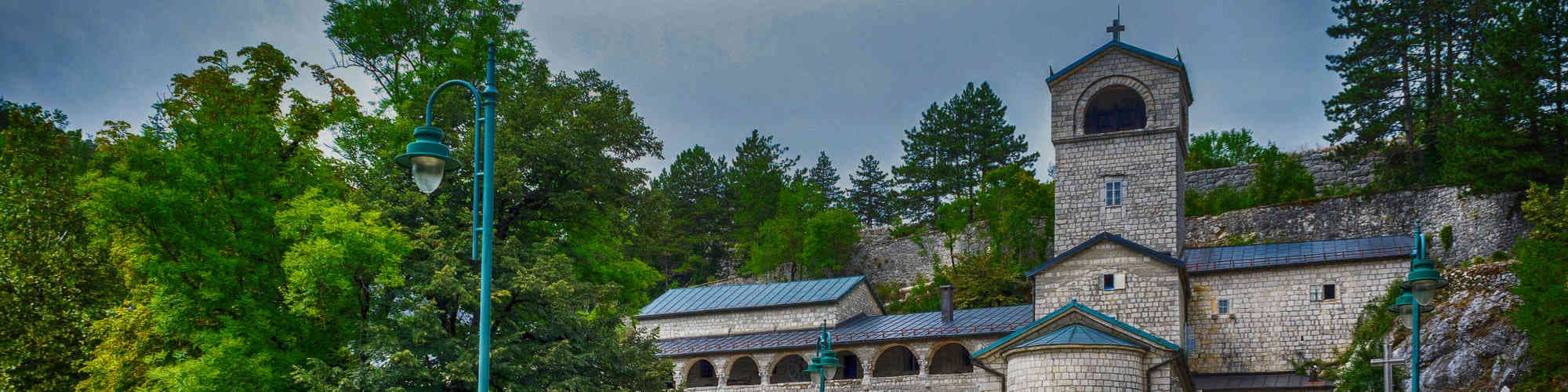
Tucked into a small karst field at the foot of Mount Lovcen, Cetinje feels like stepping into a different Montenegro altogether. There are no beach bars here, no cruise ship crowds, no souvenir shops hawking refrigerator magnets. Instead, you find wide boulevards lined with linden trees, faded embassies that once hosted ambassadors from Europe's great powers, and a monastery holding relics that have drawn pilgrims for centuries. This is Montenegro's soul -- the town that served as the nation's capital for over four hundred years and shaped everything from its literature to its national identity.
Cetinje today holds the official title of Old Royal Capital, and while Podgorica handles the business of modern government, Cetinje remains the country's spiritual and cultural heart. With fewer than 14,000 residents and a pace of life that feels decades removed from the coastal bustle, it rewards visitors who come looking for substance over spectacle.
Table of Contents
- A Brief History of Cetinje
- Cetinje Monastery
- King Nikola's Palace
- Embassy Row
- Biljarda -- The Billiard Hall
- Vlach Church
- National Museum of Montenegro
- Lovcen National Park and the Njegos Mausoleum
- Where to Eat in Cetinje
- Day Trips from Cetinje
- Where to Stay
- Getting to Cetinje
- Practical Tips for Visiting Cetinje
A Brief History of Cetinje
Cetinje's story begins in 1482, when Ivan Crnojevic -- ruler of the medieval state of Zeta -- moved his court from Obod on the Crnojevic River to a more defensible position on the small plain beneath Lovcen. He built a monastery and a modest palace, and a capital was born. Within a decade, his son Djuradj established the Crnojevic printing house here, one of the first printing presses in southeastern Europe, which produced the Oktoih Prvoglasnik in 1493 -- the earliest printed book among the South Slavs.
When the Crnojevic dynasty faded, it was the Petrovic-Njegos family that picked up the thread. Beginning with Bishop Danilo in 1697, the Petrovic dynasty ruled Montenegro for 222 years, governing from Cetinje through centuries of Ottoman pressure. During this long stretch, Montenegro was one of the few territories in the Balkans that was never fully conquered by the Ottoman Empire. The Montenegrins fought from their mountain strongholds with such tenacity that the region earned the nickname "Serbian Sparta" -- a comparison to the warrior society of ancient Greece that tells you everything about how this small land was perceived by its neighbors and enemies alike.
The Congress of Berlin in 1878 brought international recognition, and Cetinje suddenly found itself on the diplomatic map of Europe. Embassies sprang up along its main streets, their grand facades announcing the presence of Russia, France, Britain, Italy, Austria-Hungary, and the Ottoman Empire. In 1910, Prince Nikola I Petrovic-Njegos declared himself king, and Cetinje became the capital of the Kingdom of Montenegro -- a status it held until the country was absorbed into the Kingdom of Serbs, Croats, and Slovenes after World War I.
When Yugoslavia took shape and then dissolved, and when Montenegro regained independence in 2006, Podgorica was the seat of government. But Cetinje was granted the honorary title of Old Royal Capital -- a constitutional acknowledgment that some things matter too much to forget.
Cetinje Monastery
The Cetinje Monastery is the spiritual center of Montenegro and the seat of the Montenegrin Metropolitan of the Serbian Orthodox Church. The current structure dates to 1701, built on the foundations of earlier monasteries that were repeatedly destroyed during Ottoman raids. Its thick stone walls and modest exterior give no hint of what lies inside.
The monastery houses two relics of extraordinary significance. The first is the right hand of Saint John the Baptist -- the hand believed to have baptized Jesus Christ. The relic traveled a remarkable path: from Jerusalem to Constantinople, through the courts of Ottoman sultans and the Knights of Malta, before reaching the Russian imperial family. When the Bolshevik Revolution scattered the Romanovs, the hand was eventually brought to Montenegro, first to Ostrog Monastery and later to Cetinje.
The second major relic is a fragment of the True Cross. The monastery also holds the remains of Saint Peter of Cetinje, his bishop's crown, and the icon of the Philermos Mother of God, traditionally attributed to Saint Luke the Evangelist.
Visiting is free and the monastery is open daily. Dress modestly -- shoulders and knees must be covered, and women are asked to wear a headscarf and skirt. Photography inside the chapel is not permitted. The relics are not always on display; a monk may bring them out for small groups, so patience is part of the experience. A church shop sells candles, icons, and devotional items.
King Nikola's Palace
Across the main square from the monastery stands the palace of King Nikola I Petrovic-Njegos, the last ruler of independent Montenegro. Construction began in 1863, and the building served as the royal residence until 1918. Nikola was a fascinating figure -- a poet, a politician, and a shrewd dynast who married his daughters into the royal families of Italy, Serbia, and Russia, earning himself the nickname "Father-in-Law of Europe."
Since 1926, the palace has functioned as a museum and is now part of the National Museum of Montenegro. The ground floor displays royal furniture, personal effects, and ornate reception rooms, giving you a tangible sense of court life in a kingdom grand in ambition if modest in size.
The weapons collection is the real draw. The museum holds an extraordinary array of swords, rifles, pistols, and edged weapons accumulated over centuries of conflict, alongside 44 captured Ottoman battle flags and military decorations that fill the upper rooms. A library and archive of more than 10,000 items includes copies of the incunabula from the Crnojevic printing house. For anyone interested in Montenegrin history, this museum alone justifies a trip to Cetinje.

Embassy Row
One of Cetinje's most distinctive features is its collection of former embassies -- grand European buildings that look slightly out of place in this small mountain town. After the Congress of Berlin granted Montenegro international recognition in 1878, the great powers of Europe sent their representatives to Cetinje, and each built an embassy befitting their national prestige.
Walking along the town's main streets, you encounter these buildings one after another. The former French Embassy, designed by architect Paul Gaudet, now serves as part of the National Library. The imposing Russian Embassy houses the Faculty of Fine Arts. The British Embassy became the Music Academy. The Italian Embassy is now the Central National Library "Djurdje Crnojevic." The former Ottoman Embassy hosts the Faculty of Drama. The Serbian Embassy building contains the Ethnographic Museum. The Austro-Hungarian and German legation buildings are also present.
What makes this remarkable is the concentration. In most capitals, embassies are scattered across a large city. In Cetinje, you can walk past the diplomatic missions of six or seven great powers in ten minutes -- a physical reminder of a time when this town of a few thousand people was a legitimate player on the European stage.

Biljarda -- The Billiard Hall
Just steps from the monastery, the Biljarda is a fortified residence built in 1838 for Prince-Bishop Petar II Petrovic-Njegos, Montenegro's most celebrated literary figure. The building was constructed with significant financial help from Russia, and its thick walls and corner towers give it the appearance of a small fortress rather than a palace -- fitting for a ruler who governed a land perpetually at war.
The name Biljarda comes from the billiard table that Njegos loved to play on. The table itself, imported from Italy, had to be carried on the backs of men from the port of Kotor up through the mountains to Cetinje -- an absurd logistical feat that says something about both Njegos's tastes and the determination of the people who served him. The original table is still on display inside.
Today the Biljarda houses the Njegos Museum, which contains personal belongings, furniture, manuscripts, and the most famous portrait of Njegos himself. But the building's most impressive feature is housed in a separate glass-walled annex: a massive relief map of Montenegro created by the Austro-Hungarian military during their occupation in 1916-1917. Spread across approximately 180 square meters, the map is built to a scale of 1:10,000 by area and 1:15,000 by height. Every mountain, valley, and river is rendered in extraordinary detail. Standing above it, you begin to understand Montenegro's geography in a way that no flat map can convey -- the impossibly rugged terrain that made this country so difficult to conquer.

Vlach Church
The Vlach Church, known locally as Vlaska Crkva, is the oldest surviving building in Cetinje. Its origins date to around 1450, predating even Ivan Crnojevic's founding of the town, when it was built on the site of a Bogomil necropolis containing around 150 stecci -- the ornate medieval tombstones characteristic of the western Balkans.
The church has been rebuilt several times. It began as a simple structure of sticks and mud, was later reconstructed in stone, and received its current form in 1864. Inside, it is modest -- simple icons and a quiet atmosphere.
But what draws visitors is the fence. The churchyard is enclosed by a railing constructed in 1897 from the barrels of approximately 1,544 Ottoman rifles captured during the Montenegrin-Ottoman wars of the 1870s. The barrels stand vertically, creating a barrier that is both functional and deeply symbolic -- one of the most striking war monuments in the Balkans, not a statue or a plaque, but an everyday object fashioned from the instruments of warfare.

National Museum of Montenegro
The National Museum of Montenegro is not a single building but a complex institution overseeing five separate departments spread across Cetinje's historic center: King Nikola's Museum, the Art Museum, the Historical Museum, the Ethnographic Museum, and the Njegos Museum at the Biljarda. It also administers the Njegos Mausoleum on Mount Lovcen and the Njegos Birthplace in the village of Njeguski.
For art lovers, the Art Museum is the highlight. Founded in 1950 with an initial collection of 240 works, it has grown to over four thousand pieces organized into several sub-collections: icons, Montenegrin fine arts, Yugoslav fine arts, foreign artists, reproductions of medieval frescoes, and several legacy collections. The most important single work is the icon of Our Lady of Philermos, a precious 9th-century icon traditionally believed to have been painted by Saint Luke the Evangelist. The icon collection, while small, includes works that span centuries of Orthodox religious art.
The Ethnographic Museum, housed in the former Serbian Embassy, displays traditional Montenegrin costumes, household items, tools, and musical instruments -- offering a window into rural life in the mountains that surrounded and sustained Cetinje for centuries.
A combined ticket covering all five museums is available and saves money compared to purchasing individual entries. Plan at least half a day if you intend to visit more than two of the sites.

Lovcen National Park and the Njegos Mausoleum
No visit to Cetinje is complete without ascending Mount Lovcen. The national park begins almost immediately outside town, and the road to the summit winds through dense beech and pine forests with increasingly dramatic views at every turn.
The centerpiece of Lovcen is the Njegos Mausoleum, perched at 1,657 meters on Jezerski Vrh, the mountain's second-highest peak. To reach it, you must climb 461 steps through a tunnel carved into the rock -- a passage that rises 60 meters through the mountain before emerging on the summit platform. The climb is steady but manageable for anyone in reasonable health; take your time and pause to catch your breath.
The mausoleum itself is the work of Croatian sculptor Ivan Mestrovic. Inside, beneath a golden mosaic ceiling composed of 200,000 tiles, sits a 28-tonne granite statue of Njegos with an eagle perched on his arm and an open book in his lap. The crypt below is lined in green marble. It is a monument of extraordinary power, matching the scale of the mountain itself.
But it is the view that most visitors remember. On a clear day, you can see the Adriatic Sea, the Bay of Kotor, Lake Skadar, the mountains of Durmitor in the north, and on the finest days, the coasts of Albania and even Italy across the water. There are few viewpoints in Europe that offer such a range of landscapes in a single panorama.
Beyond the mausoleum, Lovcen National Park offers hiking trails of varying difficulty. Ivanova Korita, the park's recreational center, sits at a lower elevation and serves as a base for several routes. You can hike from Ivanova Korita to the mausoleum in approximately 1.5 to 2 hours -- a moderate-to-difficult trek covering about 9 kilometers with over 400 meters of elevation gain. The area around Ivanova Korita also has picnic facilities, a restaurant, and a small visitor center with trail maps.
The national park entrance fee is separate from the mausoleum admission.
Where to Eat in Cetinje
Cetinje is not a culinary destination in the way that the coast is, and that is precisely its appeal. The restaurants here serve Montenegrin food for local people, not tourist menus with photographs. Portions tend to be large, prices are lower than on the coast, and the cooking is honest.
Restaurant Kole is the standout. Located a few hundred meters from the Palace Square, it occupies a handsome building with a warm interior and serves what many locals consider the best food in town. The menu features Njeguski prsut (dry-cured ham from the village of Njeguski, just up the road), smoked meats, lamb prepared several ways -- boiled, roasted, or cooked in milk -- and fresh carp from Lake Skadar prepared on volcanic lava stone. The koset (smoked beef ham) is excellent. International options exist on the menu but stick to the Montenegrin dishes. Open daily from early morning to late evening.
Beyond Kole, several kafanas and small restaurants around the main square serve reliable grilled meats, salads, and traditional stews. Cetinje is also a good place to try cicvara (a rich cornmeal and cheese dish) and kacamak (a similar preparation), both mountain staples that you will not often find on coastal menus. Local bakeries sell burek and other pastries for quick, inexpensive meals.
Coffee culture is strong in Cetinje. Sitting in one of the cafes on the main boulevard with a strong domestic coffee, watching the unhurried pace of the town, is itself a worthwhile experience.
Day Trips from Cetinje
Cetinje's central position between the coast and the interior makes it an excellent base for day trips in several directions.
Lovcen Summit (30 minutes by car): The road from Cetinje to the Njegos Mausoleum parking area takes roughly 30 minutes. Combine the mausoleum visit with a stop at the village of Njeguski, birthplace of Njegos and home to Montenegro's most famous prsut and cheese. Several family producers offer tastings.
Kotor via the Serpentines (45-60 minutes): The old P1 road from Cetinje to Kotor is one of the most spectacular drives in Europe -- 25 hairpin turns over 8.3 kilometers, dropping more than 400 meters from the Lovcen plateau to the Bay of Kotor. The views from above are breathtaking. Drive early to avoid tour buses on the narrow road.
Podgorica (30 minutes): The modern capital is a straight, easy drive from Cetinje. While Podgorica is not Montenegro's most picturesque city, it has good restaurants, the Millennium Bridge, the Cathedral of the Resurrection, and serves as a transport hub for onward travel.
Lake Skadar (45 minutes): Southern Europe's largest lake lies between Montenegro and Albania. Boat tours from Virpazar explore the lake's islands, monasteries, and bird habitats -- including one of Europe's last pelican colonies.
Where to Stay
Accommodation in Cetinje is limited compared to the coast, but what exists is genuine and affordable.
Grand Hotel is the most established option -- a three-star property in the center of town with clean rooms, an indoor pool, sauna, free breakfast, and an on-site restaurant. It is within walking distance of every major sight. Rooms start from around 70-80 euros per night, making it significantly cheaper than comparable hotels on the coast. Free parking is available.
Beyond the Grand Hotel, a growing number of small guesthouses, apartments, and private rooms are available through booking platforms. These tend to be family-run, modestly furnished, and very affordable -- with the kind of warm hospitality that only non-touristy places can manage.
For those with a car, staying in Cetinje and driving to the coast for day trips is a budget-friendly alternative to booking accommodation in Kotor or Budva during peak season.
Getting to Cetinje
From Podgorica: The drive from Podgorica to Cetinje takes approximately 30 minutes on a straightforward two-lane road. Regular bus service connects the two cities throughout the day, with the journey taking about 40 minutes.
From Kotor via the Lovcen Serpentines: This is the dramatic route -- 25 hairpin turns climbing from the bay to the Lovcen plateau, then continuing to Cetinje. Allow 45 minutes to an hour. The road is paved but narrow; drive carefully around buses. Not recommended in poor weather.
From Budva: About 30 to 40 minutes via Podgorica, or slightly longer via the scenic mountain road.
By Bus: Regular services run from Podgorica, Budva, and Kotor. Schedules are limited, so check departure times in advance. There is no train service to Cetinje.
From Tivat Airport: Roughly 50 minutes by car. Podgorica Airport is about 45 minutes away.
Practical Tips for Visiting Cetinje
Combine Cetinje with Lovcen. The most rewarding way to experience both is to spend a night in Cetinje, visit the town's museums and monastery in the afternoon, then drive up to the Njegos Mausoleum the following morning when the air is clearest and the views are best.
Monastery dress code. Cover your shoulders and knees. Women should bring a headscarf and a long skirt or wrap. The monastery is a functioning religious site, not a museum, and dress requirements are taken seriously.
Museum tickets. A combined ticket covering all five departments of the National Museum of Montenegro is the most economical option if you plan to visit more than two sites. Individual tickets are also available at each location.
Cetinje is quieter than the coast. That is the point. Come here for the history, the culture, and the chance to see a side of Montenegro that most tourists miss entirely. The town moves at its own rhythm -- shops may close for long lunches, and not everything runs on a strict schedule.
Weather. At around 670 meters elevation, Cetinje receives significantly more rain than the coast. Even in summer, bring a light jacket for cool mornings. In winter, snow is common and the road to Lovcen may be closed from November through March.
Cultural significance. Montenegrins view Cetinje with a reverence that is difficult to overstate. This is where their state was born, where their literature was printed, where their church has its seat, and where their independence was defended. Approach the town and its monuments with the respect that this history deserves.
Time needed. A focused visit to the main sights can be accomplished in a half-day. But to see the museums properly, visit the monastery, and make the trip up to Lovcen, plan for a full day or -- better still -- an overnight stay. Two nights allow a genuinely relaxed pace, with time for a day trip to Kotor or Lake Skadar.
Language. English is less widely spoken here than on the coast, but younger residents and museum staff generally manage well. A few words of Montenegrin -- dobar dan (good day), hvala (thank you), molim (please) -- go a long way.
Cetinje will not dazzle you with beaches or nightlife. It will do something better: it will show you the history, the faith, and the stubborn independence that made Montenegro what it is. For travelers who want to understand this country rather than simply visit it, there is no better place to begin.